
Researching a company involves much more than collecting basic information from its website. A meaningful assessment may require looking at the company’s background, products or services, business model, leadership, financial information, industry, competitors, opportunities, and potential risks.
A research dossier for target company provides a structured way to organize these findings. It can help researchers bring information from different sources into one place, evaluate what is known, identify information gaps, and separate verified facts from assumptions.
There is no single legally required format for a company research dossier. Its contents depend on the purpose of the research and the type of company being examined. For example, research prepared for investment analysis may emphasize financial information, while competitive research may focus more heavily on products, customers, competitors, and market conditions.
What Is a Research Dossier for Target Company?
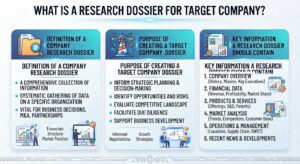
A research dossier for target company is an organized collection of relevant information, evidence, and analysis about a particular business.
The goal is to create a clearer picture of the company by bringing together information that may otherwise be scattered across regulatory filings, company publications, government records, industry materials, and other credible sources.
Definition of a Company Research Dossier
A company research dossier can be described as a structured research document that records important information about a business and provides supporting evidence for significant findings.
For publicly traded companies, regulatory filings can be an important source of information. In the United States, for example, public companies generally provide information through SEC filings such as annual reports, quarterly reports, and current reports.
Purpose of Creating a Target Company Dossier
The purpose of creating a target company dossier is to organize information so that the business can be evaluated more systematically.
Instead of keeping separate notes about financial results, leadership, competitors, products, and risks, the researcher can bring the relevant findings together in a single framework.
A dossier can also support due-diligence activities. Risk-based due diligence involves identifying and assessing actual or potential adverse impacts and determining appropriate responses. The OECD’s guidance emphasizes prioritizing significant risks rather than assuming that every issue has the same importance.
Key Information a Research Dossier Should Contain
The information included should reflect the purpose of the research. A comprehensive dossier may contain:
- Company background and history
- Ownership and corporate structure
- Products and services
- Business model
- Leadership and governance
- Financial information
- Industry and market conditions
- Competitor information
- Business opportunities
- Potential risks
- Regulatory considerations
- Important developments
- Research dates
- Supporting evidence
- Unresolved questions and information gaps
The most important consideration is relevance. A dossier should contain information that helps answer the specific questions behind the research rather than simply becoming a collection of unrelated facts.
Why Is a Research Dossier Important for a Target Company?
A company can look very different depending on which information is examined.
Financial results may show one aspect of a business, while research dossier for target company competitive environment, leadership, products, regulatory exposure, and operating risks may reveal other important considerations.
Supporting Better Business Decisions
Good business decisions depend on relevant and reliable information. A dossier can organize company facts, financial information, market conditions, competitor information, and identified risks so that decision-makers can review the evidence more efficiently.
Research dossier for target company does not guarantee that a decision will be successful. Business conditions can change, and available information can be incomplete. Its main benefit is that it creates a more organized evidence base for the decision-making process.
Understanding the Company’s Market Position
A company’s position cannot always be understood by examining the business alone. Researchers should consider the products or services offered, the customers served, geographic markets, competing businesses, substitutes, and other factors affecting competition.
Competition authorities commonly examine relevant product and geographic markets when evaluating competitive conditions. Such analysis demonstrates why a target company’s position needs to be considered within the wider market rather than in isolation.
Identifying Opportunities and Potential Risks
Company research should examine both potential opportunities and potential risks. Opportunities may involve new products, new customer groups, geographic expansion, technological developments, or changes in market demand. Risks may include intense competition, financial pressure, regulatory changes, operational difficulties, supply-chain problems, or technological disruption.
What Information Should a Target Company Research Dossier Include?
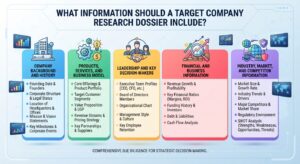
There is no universal checklist for every business. The appropriate information depends on the company’s industry, ownership structure, size, geographic reach, and the purpose of the research.
However, several categories are commonly useful when preparing a broad company assessment.
Company Background and History
Begin with the company’s basic identity and development. Depending on the information available, this section can cover the company’s founding, headquarters, ownership, corporate structure, major business changes, acquisitions, strategic developments, and other significant milestones.
For public companies, regulatory filings can provide an important historical record of corporate developments and reported business information.
Products, Services, and Business Model
The dossier should clearly explain what the company sells and how the business operates. Research can cover major products or services, target customers, sales channels, geographic markets, and other available information about the company’s operations.
The business model section should answer a basic question: How does the company create and generate economic value?
Researchers should also distinguish between a company’s description of Research dossier for target company products or strategy and independently verified information about its actual business activities.
Leadership and Key Decision-Makers
Leadership research can help establish who is responsible for directing the company. Depending on the company, this may include executives, directors, founders, or other important decision-makers.
For public companies, leadership information may be available through regulatory filings and official corporate disclosures.
Financial and Business Information
Financial information is an important part of many company research projects, particularly when the research concerns investment, lending, acquisition, or financial risk.
Relevant information may include revenue, expenses, profitability, assets, liabilities, cash flows, debt, and other reported financial measures. For U.S. public companies, SEC filings such as annual and quarterly reports provide important primary information about reported financial results.
Industry, Market, and Competitor Information
A target company should be studied within Research dossier for target company broader industry and market. Research may cover major competitors, customer groups, substitute products or services, geographic markets, barriers to entry, market concentration, and other competitive factors.
The U.S. Department of Justice explains that market analysis can involve identifying relevant product and geographic markets and determining which businesses participate in those markets.
How to Research a Target Company
A systematic research process can make company analysis more reliable and easier to update. The process should begin with a clear objective and continue through information collection, verification, analysis, organization, and review.
Define the Research Objectives
Before collecting information, establish exactly what the research is supposed to determine.
For example, the objective could be:
- Understanding a company’s business
- Evaluating a potential investment
- Conducting competitive research
- Assessing a possible business relationship
- Supporting acquisition research
- Reviewing potential business risks
- Understanding an industry participant
The objective determines which information deserves the most attention.
Collect Relevant Company Information
Start with the strongest available sources. For public companies, regulatory filings can provide primary information about reported financial results, business operations, and significant events.
Company websites and official publications may provide information about products, services, leadership, strategy, and corporate activities. Government agencies, regulators, recognized industry organizations, and reputable research sources can provide additional context.
Analyze the Company and Its Industry
After collecting information, the next step is analysis. Examine the company’s business model, financial position, products, competitive environment, industry conditions, opportunities, and potential risks.
Competitive analysis should consider more than price. Competition can involve product quality, features, innovation, service, customer relationships, geographic reach, and other dimensions depending on the industry.
Organize and Compare Research Findings
Organize the findings into logical categories.
A practical dossier can separate information into:
- Verified facts
- Company-reported information
- Independent evidence
- Analytical observations
- Uncertain information
- Research gaps
This approach makes the document easier to review and reduces the risk of presenting an interpretation as if Research dossier for target company were a confirmed fact.
How to Verify Information in a Research Dossier
Verification is one of the most important stages of preparing a reliable research dossier. Online information can be incomplete, outdated, incorrectly repeated, or presented without sufficient context. Important claims should therefore be checked before they become part of the final assessment.
Check Information From Multiple Sources
Important information should be compared with reliable sources whenever practical. For example, information reported on a company website may be compared with regulatory filings, government records, or other credible independent sources.
Separate Verified Facts From Assumptions
A strong dossier clearly distinguishes facts from interpretation. For example, a financial filing can establish what revenue a company reported for a particular period. A researcher’s conclusion about whether that revenue indicates strong future growth is an analytical judgment.
Identify Outdated or Conflicting Information
Company information can change quickly. Leadership, financial results, ownership, products, regulations, competitors, and strategic priorities may change over time.
If two credible sources provide different information, the discrepancy should be investigated. Researchers should consider publication dates, reporting periods, source authority, and whether the information refers to different circumstances.
Keep the Dossier Accurate and Updated
A company dossier should be updated when important information changes. The appropriate schedule depends on the purpose of the research. A company being actively evaluated for a transaction may require more frequent monitoring than a company being studied for general background information.
Useful update practices include recording research dates, reviewing important sources periodically, replacing outdated information, and marking unresolved questions.
How to Analyze a Target Company
Research becomes more valuable when collected information is converted into structured analysis.
The objective is not to predict the future with certainty. Instead, the researcher should use available evidence to understand the company’s current position, potential opportunities, and material risks.
Evaluate Business Strengths and Weaknesses
Assess factors that may influence the company’s ability to compete and operate successfully.
These may include its products, customer relationships, financial resources, operational capabilities, technology, brand position, geographic reach, or other company-specific characteristics.
A strength should be supported by evidence rather than simply by promotional language. The same principle applies to weaknesses.
Examine Growth Opportunities
Look for evidence of potential expansion. Possible areas include new products, new customer groups, geographic markets, technological developments, increased demand, or changes in industry conditions.
However, a potential opportunity should not automatically be described as expected growth.
Identify Potential Risks and Challenges
Risk analysis should focus on issues that could materially affect the company or the decision being considered.
Depending on the business, this may include:
- Competitive pressure
- Financial risk
- Regulatory exposure
- Operational problems
- Supply-chain dependence
- Technology changes
- Cybersecurity concerns
- Customer concentration
- Geographic exposure
- Legal or compliance issues
Not every possible risk deserves equal attention. Risk-based due diligence emphasizes identifying and prioritizing significant actual or potential impacts.
Compare the Company With Its Competitors
Competitor comparison provides context for the target company’s performance and position.
Relevant comparison factors may include products, services, pricing where reliable information is available, geographic presence, customer segments, business models, financial indicators, capabilities, and other meaningful competitive dimensions.
Benefits of Creating a Research Dossier for Target Company
A well-organized dossier can make complex company research easier to understand, review, and update. Research dossier for target company value comes from combining relevant information with source tracking, verification, and structured analysis.
Improves Business and Investment Research
A dossier can bring important company information into one organized framework. For investment research, financial filings and corporate disclosures can provide evidence about reported financial performance and significant business developments.
The dossier does not replace professional financial advice or independent analysis. Research dossier for target company role is to make the underlying research easier to organize and evaluate.
Supports Competitive Analysis
Competitive research is more useful when information about the target company and its competitors is examined together.
A structured dossier can make Research dossier for target company easier to compare products, markets, customers, capabilities, geographic presence, and other relevant competitive factors.
This can help researchers understand where the target company competes directly and where its competitive environment differs.
Helps With Due Diligence
A research dossier can provide useful background for due-diligence work by organizing information and highlighting areas that require further investigation.
The OECD describes due diligence as a risk-based process for identifying, preventing, mitigating, tracking, communicating, and addressing adverse impacts.
However, a general research dossier should not be represented as a substitute for specialized legal, financial, tax, technical, environmental, or other professional due diligence.
Makes Important Information Easier to Understand
Company information can be spread across numerous documents and sources. A structured dossier can bring the most relevant findings together while preserving enough source information to allow important claims to be checked. This makes the research easier for another person to review and can reduce repeated research work.
Read more: How Does Startupbooted Work? Everything You Should Know
Common Mistakes to Avoid in Company Research
Even a detailed dossier can produce poor results when the underlying research process is weak. Avoiding common research mistakes can improve accuracy and make the final analysis more useful.
Relying on Unverified Information
Information should not be treated as reliable simply because Research dossier for target company appears online. Important claims should be checked against authoritative or credible sources, particularly when the information could materially affect the research conclusion.
Using Outdated Company Data
Old information can create an inaccurate picture of a current business. Always check publication dates, reporting periods, leadership information, financial periods, and other indicators of currency.
Ignoring Industry and Competitor Analysis
Studying only the target company can produce an incomplete assessment.
A company may appear strong when viewed independently but face substantial competitive pressure when its products, customers, substitutes, market position, and competitors are considered.
Making Conclusions Without Enough Evidence
A common research mistake is turning an assumption into a fact. For example, the existence of a new product does not prove that it will become commercially successful. Similarly, revenue growth in one period does not by itself prove that long-term growth will continue.
Final Thoughts
A research dossier for target company is most useful when it goes beyond collecting basic facts. A strong dossier organizes relevant information, identifies reliable evidence, checks important claims, evaluates the company’s competitive environment, and clearly separates facts from analysis.
The research should begin with a defined objective and use the strongest available sources for each type of information. Public-company filings can provide valuable corporate and financial information, while government records, regulatory materials, company disclosures, and credible industry sources can add further context.
FAQs About research dossier for target company
1. What Is a Research Dossier for Target Company?
A research dossier for a target company is a structured collection of relevant information, evidence, and analysis about a particular business.
2. What Should Be Included in a Company Research Dossier?
A company research dossier can include company background, ownership, products and services, business model, leadership, financial information, market conditions, competitors, opportunities, risks, regulatory considerations, supporting evidence, and research dates.
3. How Do You Research a Target Company?
Begin by defining the research objective. Then collect information from reliable primary and secondary sources, analyze the company and Research dossier for target company industry, compare important findings, verify significant claims, organize the evidence, and clearly distinguish confirmed facts from assumptions or analytical conclusions.
4. Why Is Company Information Verification Important?
Verification helps reduce the risk of using inaccurate, incomplete, outdated, or unsupported information.
5. How Often Should a Research Dossier Be Updated?
There is no universal update schedule. The frequency should depend on the purpose of the dossier and how quickly relevant information changes.