
Understanding investing can be difficult when financial terminology, market information, and different investment choices all appear at once. Gomyfinance.com Invest is the investment-focused part of GoMyFinance.com, bringing together educational content, investing guidance, market-related information, and financial tools designed to help readers better understand money and investing.
GoMyFinance’s current investment material focuses on several basic principles, including setting clear financial goals, diversification, controlling costs, maintaining a suitable investment time horizon, and making consistent contributions. The site also discusses different asset types, including stocks, bonds, funds, real estate, and cash.
For readers researching Gomyfinance.com Invest, the most important point is to understand its role accurately. The available material presents it primarily as an educational and financial-resource framework rather than something that should automatically be treated as a traditional brokerage account.
What Is Gomyfinance.com Invest?
Gomyfinance.com Invest is the investing section and framework within GoMyFinance.com. According to its current investment guide, it brings together investment guides, explanations, and tools for people at different stages of their investing journey.
The site’s investment resources cover fundamental topics such as asset classes, diversification, investment strategies, risk, costs, and long-term planning. GoMyFinance also publishes financial calculators and broader personal-finance resources that can be useful when planning around investment goals.
Understanding the Platform
GoMyFinance.com is a broader financial education website rather than an investment-only resource. Gomyfinance.com Invest stated areas include personal finance, investing, financial literacy, market news and analysis, investment strategies, company and sector analysis, and financial calculators.
Within the investment section, readers can find articles covering subjects such as stocks, real estate, dividend investing, certificates of deposit, and other investment-related topics.
This broader structure means that Gomyfinance.com Invest can be viewed as part of a wider financial-learning resource. Someone researching an investment topic can also explore related subjects such as budgeting, saving, debt, and retirement planning.
Who May Be Interested in Using It?
The resources may be useful to beginners who are learning basic investment terminology as well as more experienced readers looking for additional financial information. GoMyFinance says its content is intended to explain financial concepts clearly and provide resources for different levels of financial knowledge.
Beginners may find topics such as diversification, risk, asset allocation, and compound growth particularly useful. More experienced investors may use the investment articles as one source of background information when researching a financial subject.
However, educational information should not be confused with individualized financial advice. Investment decisions depend on a person’s goals, financial circumstances, time horizon, and tolerance for risk.
Exploring Gomyfinance.com Investment Tools
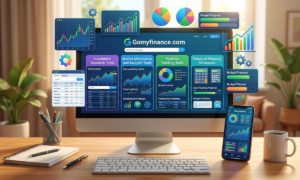
The investment resources associated with Gomyfinance.com Invest include educational guides, market-related information, investment strategy material, and financial calculators. GoMyFinance specifically identifies calculators and tools as part of its broader financial-resource offering.
These resources are most useful when they help readers understand a financial question rather than encourage them to rely on a single calculation or article.
Investment Research Tools
Investment research starts with understanding the asset or strategy being considered. GoMyFinance publishes educational material about different investment approaches and asset classes, including stocks, real estate, dividend investing, and other investment topics.
The site’s investment strategy material discusses approaches such as value investing, growth investing, and income investing.
These resources can provide background knowledge, but readers should verify important current information through appropriate primary and authoritative sources before making an investment decision.
Market Information and Analysis Tools
GoMyFinance states that it provides market news and analysis covering financial events, stock-market trends, and economic indicators. Gomyfinance.com Invest also describes company and sector analysis as part of its investor-focused resources.
This type of information can help readers understand why markets or particular sectors may be receiving attention. However, market commentary is not the same as a guarantee about future performance.
When using market information, it is sensible to check the date of the material because financial conditions, prices, interest rates, and economic data can change.
Portfolio Tracking Tools
Portfolio management is discussed in GoMyFinance’s investment material through subjects such as diversification, asset allocation, investment costs, time horizon, and periodic portfolio review.
However, the current public material does not provide enough evidence to claim that GoMyFinance.com itself functions as a live brokerage portfolio tracker for users. Therefore, Gomyfinance.com Invest is more accurate to describe its portfolio-related material as educational guidance about portfolio management.
For actual account balances and investment performance, investors should rely on the statements and tools provided by their investment provider.
Financial Planning Resources
Financial planning is an important part of the GoMyFinance ecosystem. The site provides financial calculators covering areas such as investment planning, retirement planning, budgeting, debt, and savings.
Financial calculators can turn assumptions such as contributions, interest rates, returns, or time periods into hypothetical figures. They can therefore be useful for comparing scenarios before making a financial plan. The results, however, depend on the information and assumptions entered. A calculator projection should not be interpreted as a guaranteed future result.
Key Features of Gomyfinance.com Invest
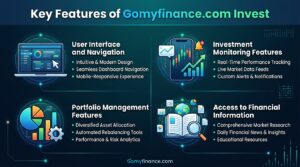
The main characteristics of Gomyfinance.com Invest are its investment education, strategy-focused content, market information, and connection to broader financial planning resources.
User Interface and Navigation
GoMyFinance.com organizes its material into categories such as investments, personal finance, calculators and tools, and other financial subjects. Gomyfinance.com Invest homepage currently highlights investment and financial-planning content alongside other money-related guides.
This category-based approach allows readers to move from a specific investment question to related financial topics.
Investment Monitoring Features
Investment monitoring involves more than checking a return figure. Investors need to consider risk, diversification, costs, time horizon, and whether their investment strategy continues to match their goals.
GoMyFinance’s current investment guide discusses these areas and recommends reviewing a portfolio periodically rather than constantly reacting to short-term market movements.
The material is therefore useful for understanding the principles behind investment monitoring, even though Gomyfinance.com Invest should not be described as proof of a live portfolio-monitoring service.
Portfolio Management Features
GoMyFinance’s investment framework places emphasis on diversification, asset allocation, costs, and long-term consistency. Gomyfinance.com Invest explains that stocks, bonds, funds, real estate, and cash can serve different roles depending on an investor’s goals and tolerance for risk.
The site also discusses the importance of reviewing a portfolio over time. This provides readers with a framework for thinking about portfolio management without suggesting that GoMyFinance automatically manages their investments.
Access to Financial Information
Financial education is one of the central purposes described by GoMyFinance. Its stated resources include market analysis, investment strategies, company and sector analysis, financial literacy material, and financial news.
This range of information can help readers build a broader understanding of investing instead of looking at an investment decision in isolation.
How to Explore Gomyfinance.com Invest Tools
The best way to use Gomyfinance.com Invest resources is to begin with a specific financial question and then use the site’s educational material and tools to understand the subject.
Finding Relevant Investment Information
Start by identifying the investment topic you want to research. The GoMyFinance investment category contains material covering multiple investment subjects and asset types.
For example, someone researching long-term investing may first learn about diversification and asset allocation before moving on to specific investment products.
Tracking Investment Performance
Investment performance should be evaluated over a period that matches the investment objective. GoMyFinance’s investment guide highlights the importance of a long time horizon and warns against allowing short-term market movements to dictate long-term decisions.
Actual investment performance should be checked through the relevant investment account or provider, while GoMyFinance’s educational material can help explain concepts used when evaluating that performance.
Using Available Research Resources
GoMyFinance’s articles can provide background information about financial concepts, investment approaches, and market topics. Gomyfinance.com Invest calculators can then be used to explore hypothetical financial scenarios.
A good research process should still include independent verification, particularly when dealing with current prices, interest rates, taxes, regulations, or specific investment products.
Reviewing Portfolio Information
Portfolio review involves examining whether an investment mix still fits the investor’s objectives and risk tolerance. GoMyFinance’s investment framework highlights diversification, costs, time horizon, and periodic review as important considerations.
The actual portfolio information should come from the investor’s financial institution or investment provider.
Potential Benefits of Gomyfinance.com Invest
The potential value of Gomyfinance.com Invest lies mainly in making investment concepts easier to research and understand. GoMyFinance combines investment education with broader financial information and calculators.
Convenient Access to Investment Resources
Readers can find investment articles covering different subjects within the GoMyFinance investment category. The site’s broader financial sections also cover related areas such as budgeting, debt, saving, and retirement planning.
This can be useful because investment decisions are often connected to a person’s wider financial situation.
Tools for Organizing Investment Information
Financial calculators can help users examine hypothetical scenarios using their own numbers. GoMyFinance describes calculators as tools that can turn financial assumptions into projections or comparisons.
For example, a calculator can help illustrate how different contribution amounts or time periods could affect a hypothetical future value. The result should still be treated as an estimate rather than a promise.
Resources for New and Experienced Investors
GoMyFinance says its financial content is designed to serve readers at different levels of financial knowledge. Its investment material ranges from basic concepts to strategies and market analysis.
That range allows beginners to build foundational knowledge while giving more experienced readers additional subjects to investigate.
Important Considerations Before Using Gomyfinance.com Invest
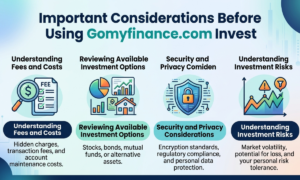
Before using any financial-information website, readers should understand what the site actually provides. In the case of Gomyfinance.com Invest, the current material supports describing it as an investment education and financial-resource framework.
Understanding Fees and Costs
Investment fees can affect long-term results. GoMyFinance’s current investment guide identifies costs as one of the important factors investors should consider.
However, readers should not assume that information about investment costs on an educational website represents the fees of a particular broker, fund, or investment product. Always check the current fee information provided by the actual financial service provider.
Reviewing Available Investment Options
Different asset classes have different characteristics. GoMyFinance discusses stocks, bonds, funds, real estate, and cash as investments that can play different roles in a portfolio.
Before choosing an investment, consider its risk, potential return, liquidity, costs, time horizon, and relationship to your existing financial goals.
Security and Privacy Considerations
Financial information should always be handled carefully. Before submitting personal or financial information to an online service, readers should review its current privacy information, terms, and security practices.
Gomyfinance.com Invest is also important to distinguish between an educational website and a regulated investment provider. If a separate service will actually hold or invest your money, verify that service independently and check its regulatory status where applicable.
Understanding Investment Risks
Investing involves risk, and the possibility of losing money cannot be eliminated simply by using research tools or educational resources.
GoMyFinance’s investment guide emphasizes diversification as one way to reduce concentration risk. Gomyfinance.com Invest also notes that diversification does not remove investment risk entirely.
Market conditions can change, investment values can decline, and projections can differ from actual outcomes. Understanding those risks is an essential part of responsible investing.
Gomyfinance.com Invest for Beginners
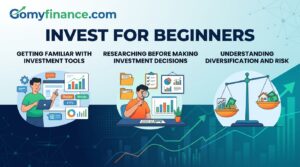
For beginners, learning the basics before choosing an investment can provide a stronger foundation. GoMyFinance’s current investment material covers subjects such as asset classes, diversification, costs, time horizons, consistent contributions, and compounding.
Getting Familiar With Investment Tools
Start by understanding what a financial tool is designed to do. An investment calculator can help illustrate a hypothetical outcome, while an educational guide can explain the concepts behind the calculation.
GoMyFinance provides calculators and tools for investment, retirement, budgeting, debt, and other financial questions.
Researching Before Making Investment Decisions
Research should come before investing. Learn how an investment works, what risks Gomyfinance.com Invest carries, what costs may apply, and how it fits into your broader financial plan.
GoMyFinance’s investment framework emphasizes clear goals, diversification, low costs, a suitable time horizon, and consistent contributions.
These principles can provide a useful educational starting point, but they do not replace individualized financial advice.
Understanding Diversification and Risk
Diversification involves spreading investments rather than relying heavily on one investment or asset. GoMyFinance identifies diversification as one of the central principles of its investment approach.
Diversification can reduce the effect of a poor result from one investment, but Gomyfinance.com Invest cannot guarantee profits or prevent losses when broader markets decline.
Read more : What Is Betterthisworld.com Gaming and How Does It Work?
Gomyfinance.com Invest Pros and Cons
| Pros of Gomyfinance.com Invest | Cons of Gomyfinance.com Invest |
| Investment-focused education: Guides cover investing concepts, strategies, and different asset classes. | Not personalized financial advice: General educational content may not address an individual investor’s circumstances. |
| Beginner-friendly explanations: Financial concepts are presented in an accessible format for | Information needs verification: Market prices, rates, regulations, taxes, and investment details can change. |
| Financial calculators and tools: Provides calculators for investments, retirement, savings, debt, and other financial planning needs. | Calculator results are estimates: Results depend on the information and assumptions entered by the user. |
| Broad financial coverage: Covers investing alongside personal finance, budgeting, and financial literacy topics. | Platform capabilities should be understood clearly: Public information supports viewing GoMyFinance primarily as an educational and financial-resource website rather than assuming it offers every brokerage function. |
Final Thoughts on Gomyfinance.com Invest
Gomyfinance.com Invest is best understood as the investment-focused part of GoMyFinance.com’s broader financial education platform. Its current resources cover investment principles, asset classes, strategies, market information, diversification, costs, financial planning, and calculators.
For someone learning about investing, these resources can provide a useful starting point for understanding financial concepts and exploring different investment questions. The site’s calculators can also help illustrate hypothetical financial scenarios.
FAQs About Gomyfinance.com Invest
What is It?
Gomyfinance.com Invest is the investment-focused framework within GoMyFinance.com, offering investment education, guides, strategies, and related financial resources.
What investment tools does Gomyfinance.com offer?
GoMyFinance provides financial calculators and investment-related educational resources covering different investment topics and asset classes. Gomyfinance.com Invest tools include resources for areas such as investment planning, retirement planning, savings, and other financial calculations.
Is Gomyfinance.com Invest suitable for beginners?
Gomyfinance.com Invest can be useful for beginners because its content explains concepts such as diversification, risk, asset classes, costs, and time horizons.
What should I consider before using Gomyfinance.com Invest?
Consider your financial goals, risk tolerance, investment time horizon, and the costs associated with any investment you are considering.
What are the risks of using online investment platforms?
Online investment services may involve market risk, potential losses, fees, security concerns, and outdated or inaccurate information. Educational tools can improve understanding, but they cannot remove the risks associated with investing.