
Workplace management is about more than assigning tasks or checking whether work is completed on time. It involves the way people communicate, responsibilities are organized, workflows are handled, and employees are supported in their daily work.
The phrase workplace management ewmagwork has appeared in recent online discussions about modern workplace practices. The Ewmagwork website places particular attention on communication, psychological safety, teamwork, employee well-being, and sustainable performance. However, Workplace management Ewmagwork is important to be precise: Ewmagwork is not established as a universally recognized management standard, certification, or single software system. Different online sources describe the term in different ways.
For beginners, the most useful approach is to understand the practical workplace-management ideas associated with the term while separating them from claims that cannot be independently verified.
What Is Workplace Management Ewmagwork?
Workplace management Ewmagwork can be understood as a term associated with organizing work while paying attention to both operational needs and the human side of working together.
The material published by Ewmagwork emphasizes issues such as unclear expectations, workplace communication, psychological safety, conflict, and employee well-being. These subjects are closely connected to broader workplace-management principles because employees need clear expectations and appropriate working conditions to perform their responsibilities effectively.
At the same time, readers should not assume that every website using the phrase is describing an official Ewmagwork framework. The term is used inconsistently online, so checking the context and original source is important.
Understanding the Meaning of Ewmagwork
There is no single, independently established definition of “Ewmagwork” that can safely be presented as an industry-wide standard. Current Ewmagwork material connects workplace management with topics such as psychological safety, communication, teamwork, employee wellness, and sustainable performance.
For beginners, Workplace management Ewmagwork is more useful to focus on the workplace principles that can be understood and applied independently, such as clear communication, defined responsibilities, healthy working relationships, and organized workflows.
The Role of Workplace Management
Workplace management helps create structure around everyday work. Employees need to know what they are responsible for, what their priorities are, who they should communicate with, and how problems should be handled. Managers also need to understand whether workloads, processes, and workplace conditions are creating unnecessary difficulties.
The International Labour Organization identifies factors including workload, working time, role clarity, autonomy, and management practices as relevant to the psychosocial working environment. This shows why effective workplace management involves more than measuring output.
Why This Topic Matters for Beginners
The topic can seem complicated because workplace management covers many different activities. Beginners can simplify it by asking a few practical questions. Who is responsible for the task? What needs to happen first? How will employees communicate? Where should important information be kept? How are problems reported? What happens when priorities change?
These questions help explain workplace management in practical terms. Understanding workplace management ewmagwork also teaches an important research skill: not every statement found online is automatically a fact. When a term has an unclear or developing definition, it is better to compare information and distinguish established principles from promotional claims.
How Workplace Management Ewmagwork Works
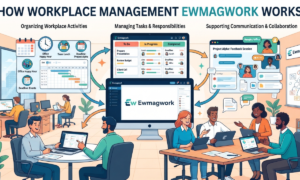
There is no verified single process that can be described as the official Ewmagwork method. Instead, the available Ewmagwork material focuses on practical issues such as psychological safety, communication, feedback, and team relationships.
These ideas can be considered alongside established workplace-management practices involving responsibilities, workflows, communication, and employee support.
Organizing Workplace Activities
Organizing workplace activities means creating a clear structure for the work that needs to be completed. This can include identifying priorities, assigning responsibilities, setting reasonable deadlines, and deciding how employees should coordinate their activities.
Good organization does not necessarily require expensive software. A small team can use a shared task list or documented process, while a larger organization may need more advanced systems. The important point is that employees should understand how their individual responsibilities fit into the wider work process.
Managing Tasks and Responsibilities
Clear responsibilities make Workplace management Ewmagwork easier for employees to understand what they are expected to do. When nobody knows who owns a task, work can be duplicated, delayed, or forgotten. On the other hand, assigning responsibility too narrowly can create problems when tasks require cooperation between several people.
A useful workplace-management process therefore combines individual accountability with team coordination. Responsibilities should also be reviewed when projects, teams, or organizational priorities change. This helps prevent old arrangements from becoming obstacles to new work.
Supporting Communication and Collaboration
Communication is a central part of workplace management. Employees need reliable ways to receive instructions, ask questions, provide updates, raise concerns, and exchange ideas. Communication becomes particularly important when teams work across different locations or schedules.
The Ewmagwork material gives significant attention to clear communication and psychological safety. Its workplace-management content argues that unclear expectations and communication problems can create unnecessary workplace tension and stress.
Key Elements of Workplace Management Ewmagwork
The ideas associated with workplace management ewmagwork can be organized around several practical areas, including people, responsibilities, communication, tasks, and workplace resources.
Employee and Team Coordination
Coordination connects individual responsibilities with team objectives. For example, one employee may collect information while another analyzes Workplace management Ewmagwork and a third prepares the final report. If the handoffs between these people are unclear, even skilled employees can experience unnecessary delays. Good coordination establishes who does what, when information should be transferred, and how team members can communicate when something changes.
Task and Time Management
Task management involves deciding what work needs to be completed and how Workplace management Ewmagwork should be prioritized. Time management is closely related, but it should not simply mean trying to fit more work into every hour. Workloads need to be realistic, and employees need enough time and resources to perform their responsibilities properly. The ILO identifies workload and working-time arrangements among the workplace factors that can contribute to psychosocial risks when they are poorly managed.
Workplace Communication
Workplace communication includes conversations, meetings, emails, written instructions, feedback, and other forms of information sharing. Effective communication should reduce uncertainty rather than create Workplace management Ewmagwork.
A manager who gives a task without explaining its purpose may leave employees guessing about priorities. Providing relevant context can help employees make better decisions without needing constant supervision. The Ewmagwork workplace-management material specifically emphasizes communication as a way to reduce workplace friction and improve team relationships.
Resource Management
Workplace resources can include employees’ time, equipment, information, facilities, technology, and financial resources. Managing resources effectively means making sure employees have what they reasonably need to complete their work.
Resource management should also consider whether existing tools actually make work easier. Adding another application or process is not automatically an improvement if Workplace management Ewmagwork creates additional complexity.
Why Effective Workplace Management Matters
Effective workplace management creates conditions in which employees can understand their responsibilities and perform their work with fewer unnecessary obstacles.
The importance of workplace conditions is supported by international occupational research. The ILO identifies work organization, job design, workload, working time, and management practices as factors that can influence psychosocial working conditions.
Improving Workplace Organization
Organization gives employees a clearer picture of how work should move from one stage to another. A simple system might identify priorities, task owners, deadlines, and required approvals. This can reduce confusion and make Workplace management Ewmagwork easier to identify work that is falling behind. Organization should support employees rather than create unnecessary bureaucracy.
Supporting Employee Productivity
Productivity should not be viewed simply as asking employees to work faster. Employees are more likely to perform effectively when expectations are clear, resources are available, and unnecessary obstacles are removed. The ILO’s work on human-centered productivity also emphasizes the relationship between workplace practices, working conditions, and organizational performance. This makes employee support an important part of sustainable productivity rather than something separate from business performance.
Encouraging Better Teamwork
Teamwork improves when employees understand their responsibilities and feel able to communicate openly. The Ewmagwork material places particular emphasis on psychological safety, describing it as an environment where people can ask questions, admit mistakes, and share ideas without fear of embarrassment or punishment.
Creating More Efficient Work Processes
Efficient processes reduce unnecessary steps and make responsibilities easier to follow. A team can improve efficiency by reviewing recurring problems, identifying unnecessary approvals, improving documentation, or clarifying communication channels.
Efficiency should not mean removing every pause or increasing workloads without limits. A process is only genuinely useful if Workplace management Ewmagwork helps employees complete important work effectively and sustainably.
Benefits of Understanding Workplace Management Ewmagwork
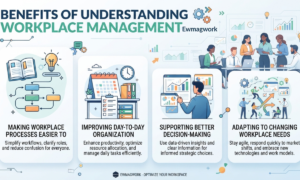
Learning about workplace management ewmagwork can give beginners a useful starting point for thinking about how people and processes interact. The greatest value comes from applying verified workplace-management principles rather than assuming that the Ewmagwork name represents a guaranteed solution.
Making Workplace Processes Easier to Understand
Clear processes help employees know what is expected. A documented workflow can explain the major steps involved in a task, identify responsibility, and show where information should be recorded. This can be particularly useful when new employees join a team or when responsibilities change.
Improving Day-to-Day Organization
Small improvements can have practical value. A team might establish clearer priorities, create a shared task list, standardize routine procedures, or decide how important information should be communicated. The goal is not to make every workplace activity formal. The goal is to make important work easier to understand and coordinate.
Supporting Better Decision-Making
Managers and employees make better decisions when they have useful information. That information might include project status, workload concerns, customer feedback, employee suggestions, or recurring process problems.
Good management also involves listening to employees because people who perform a process every day may notice problems that are not obvious from management reports alone.
Adapting to Changing Workplace Needs
Workplaces are not static. Teams grow, responsibilities change, technologies are introduced, and organizations may adopt remote or hybrid working arrangements. A process that worked well six months ago may no longer be appropriate. Effective workplace management therefore requires periodic review and adjustment rather than treating every existing procedure as permanent.
How Technology Supports Modern Workplace Management
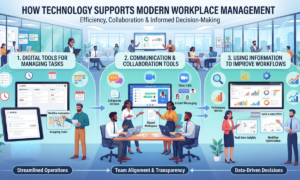
Technology can make workplace management easier, but Workplace management Ewmagwork does not replace good management. Digital tools can help teams organize tasks, communicate, store documents, schedule meetings, and monitor progress. However, the tool should support the workplace process rather than become the process itself.
Digital Tools for Managing Tasks
Task-management systems can show what needs to be done, who owns a task, and whether work is progressing. They can be useful for projects involving several employees or deadlines. However, a digital task board cannot solve unclear expectations by itself. Managers still need to define priorities and responsibilities clearly.
Communication and Collaboration Tools
Modern teams may use email, messaging applications, video meetings, shared documents, project-management platforms, and internal knowledge systems. The challenge is avoiding unnecessary fragmentation.
If important information is scattered across too many channels, employees may spend time searching for answers. A workplace should therefore establish sensible communication practices and clarify which channels are appropriate for different types of information.
Using Information to Improve Workflows
Workplace information can reveal recurring problems. For example, repeated delays might indicate unclear approval responsibilities. Frequent questions might suggest that instructions are incomplete. High workloads might indicate that priorities need to be reconsidered.
Common Workplace Management Challenges
Even a carefully organized workplace can experience management challenges. People have different responsibilities, communication styles, working preferences, and levels of experience. Effective management recognizes these differences while maintaining clear organizational expectations.
Communication and Coordination Issues
Miscommunication can lead to duplicated work, missed deadlines, and frustration. Managers can reduce these problems by clarifying responsibilities, providing useful context, and creating appropriate opportunities for questions and feedback. The Ewmagwork material identifies unclear expectations and workplace communication as important sources of workplace friction.
Managing Multiple Tasks and Priorities
Employees often have several responsibilities competing for attention. When everything is described as urgent, employees may struggle to determine what should receive priority. Managers can help by explaining which outcomes matter most and checking whether workloads are realistic.
Maintaining Efficient Workflows
Workflows can gradually become complicated as new requirements are added. A process may begin with three simple steps and eventually develop unnecessary approvals, duplicated records, and confusing handoffs. Regular process reviews can help identify these problems before they become normal parts of everyday work.
Adapting to Workplace Changes
Changes in technology, staffing, organizational priorities, or working arrangements can affect existing management processes. Rather than assuming that old procedures will continue to work, managers should review them when circumstances change. Adaptability is particularly important when teams become larger or more distributed.
Best Practices for Effective Workplace Management
The most useful workplace-management practices are generally based on clarity, communication, reasonable organization, and regular improvement.
Set Clear Roles and Responsibilities
Employees should know what they are responsible for and where their responsibilities connect with those of other team members. Clear ownership helps reduce duplicated effort and makes Workplace management Ewmagwork easier to identify gaps. Responsibilities should also be revisited when projects or organizational structures change.
Maintain Consistent Communication
Communication should be predictable enough that employees know where to find important information and how to raise questions. This does not mean filling calendars with meetings. In many cases, better documentation and clearer messages can reduce the need for unnecessary meetings.
Organize Tasks and Workflows
A useful workflow should be understandable from beginning to end. Start by identifying the major stages of the work, assigning responsibility, establishing priorities, and deciding how progress will be reviewed. If employees repeatedly struggle with the same part of a process, investigate the process itself rather than automatically blaming individuals.
Review and Improve Processes Regularly
Workplace management should be treated as an ongoing activity. Regular reviews can identify outdated procedures, communication gaps, unrealistic workloads, and unnecessary steps. Improvement does not always require a major organizational change. Sometimes a small clarification or process adjustment can solve a recurring problem.
Read more : What Is Betterthisworld.com Gaming and How Does It Work?
How Beginners Can Better Understand Ewmagwork
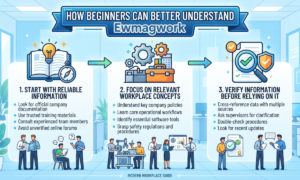
Because Ewmagwork is not presented consistently across all online sources, beginners should approach the topic carefully. The best strategy is to distinguish information published by Ewmagwork from general workplace-management research.
Start With Reliable Information
Begin with the original material associated with Ewmagwork, then compare its claims with established workplace research. This is especially important for statements about productivity, employee well-being, psychological safety, or workplace outcomes. A source should not be treated as authoritative simply because Workplace management Ewmagwork sounds professional.
Focus on Relevant Workplace Concepts
Beginners do not need to memorize every term connected with Ewmagwork. Instead, focus on practical concepts such as:
- Clear responsibilities
- Effective communication
- Team coordination
- Reasonable workloads
- Employee well-being
- Psychological safety
- Organized workflows
- Continuous improvement
These concepts provide a stronger foundation for understanding workplace management than relying on an unexplained label.
Verify Information Before Relying on It
When researching workplace management ewmagwork, check whether a claim is supported by the original source or by independent evidence. Pay particular attention to statements promising specific productivity increases, guaranteed business results, or universal management outcomes. Such claims require strong evidence before they should be presented as facts.
Final Thoughts on Workplace Management Ewmagwork
Understanding workplace management ewmagwork does not require accepting every online description of the term as established fact. The available Ewmagwork material focuses on practical workplace concerns such as communication, psychological safety, teamwork, feedback, employee well-being, and sustainable performance. These topics also connect with broader workplace-management principles involving work organization, workload, role clarity, and working conditions.
For beginners, the most useful lesson is simple: effective workplace management starts with clarity. People should understand their responsibilities, have appropriate ways to communicate, receive the information and resources needed to do their work, and have reasonable opportunities to raise concerns and suggest improvements.
FAQs About Workplace Management Ewmagwork
What is workplace management Ewmagwork?
Workplace management Ewmagwork is a term used in online content discussing workplace organization and people-focused management topics. Ewmagwork’s own material emphasizes areas such as communication, psychological safety, teamwork, and employee well-being.
Why is workplace management important?
Workplace management is important because the way work is organized can influence communication, workload, responsibilities, employee experience, and organizational performance. Effective management aims to create clearer processes and appropriate working conditions.
What are the main areas of workplace management?
Common areas include task organization, responsibilities, communication, teamwork, resource management, employee support, workflow improvement, and workplace conditions. The exact priorities depend on the organization.
How can technology support workplace management?
Technology can help teams organize tasks, communicate, share information, schedule activities, and monitor progress. However, technology works best when Workplace management Ewmagwork supports clearly defined processes rather than being used as a substitute for good management.
How can beginners learn more about Ewmagwork?
Beginners should start with the available Ewmagwork material and compare its claims with reliable workplace-management research. Because the term is not consistently defined across online sources, checking individual claims is more reliable than assuming that every page using the name describes the same framework.