
When people search for information online, finding a page is usually easy. The more difficult part is deciding how much confidence to place in what that page says. This is especially important when an article presents facts, statistics, research findings, or other claims that readers may want to share or use as evidence.
BetterThisFacts From BetterThisWorld is a phrase used in several BetterThisWorld articles published in 2026. Those pages describe BetterThisFacts as a concise, fact-focused information format containing claims, summaries, data, sources, and context.
However, there is an important distinction between a publisher’s description of its own content and independent verification of that description. BetterThisWorld says that its BetterThisFacts material uses sources and verification processes, but the available public evidence does not establish that BetterThisFacts is an independently accredited or audited fact-checking organization.
What Is BetterThisFacts From BetterThisWorld?
Understanding BetterThisFacts
BetterThisFacts is presented by BetterThisWorld as a fact-focused information format. A BetterThisWorld article published on June 17, 2026 describes the service as providing concise claims and data together with source links and context. BetterThisFacts From BetterThisWorld also describes a process involving the identification of claims, locating primary sources, and assessing supporting evidence.
Another BetterThisWorld page describes BetterThisFacts as a concise platform covering short reports, data summaries, and explainers, with an emphasis on accuracy, source clarity, and practical relevance.
These statements tell readers how BetterThisWorld presents BetterThisFacts. They should not, however, be confused with an independent certification of every claim published under the name.
The Connection Between BetterThisFacts and BetterThisWorld
The connection between the two names is visible directly on BetterThisWorld’s website. BetterThisWorld has published several articles specifically using phrases such as “BetterThisFacts From BetterThisWorld,” “BetterThisFacts By BetterThisWorld,” and “BetterThisFacts Information By BetterThisWorld.”
This makes BetterThisWorld the relevant primary source when researching what it means by BetterThisFacts. At the same time, other websites use similar BetterThisFacts wording. Because some of these pages repeat similar descriptions, readers should check the actual domain before assuming that a page represents BetterThisWorld’s own material.
What Readers May Look for in BetterThisFacts
The BetterThisWorld pages describe BetterThisFacts content as covering a range of subjects rather than one narrow field. Topics mentioned across its pages include health, environment, science, technology, policy, education, productivity, and personal development.
The exact information depends on the individual article. Therefore, readers should examine the specific claim and BetterThisFacts From BetterThisWorld source instead of assuming that every BetterThisFacts article follows exactly the same research standard.
Why People Search for BetterThisFacts
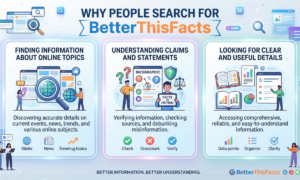
Finding Information About Online Topics
Someone searching for BetterThisFacts From BetterThisWorld may simply want to understand what the term means or locate the BetterThisWorld articles associated with it. The BetterThisWorld website currently contains multiple pages using the BetterThisFacts name, including pages published in June 2026.
Searching the exact phrase can therefore help identify relevant pages. However, a search result’s position or appearance does not establish that every statement on the page is accurate.
Understanding Claims and Statements
An informational article can contain different types of statements. A sentence may report a statistic, summarize research, interpret evidence, or provide advice. These are not interchangeable.
For example, a study’s result is evidence from a particular investigation. An author’s explanation of what that result means is an interpretation. A recommendation based on that interpretation is advice.
Looking for Clear and Useful Details
BetterThisWorld’s BetterThisFacts pages emphasize sources, data, context, and verification as parts of their stated approach.
For readers, the practical question is whether those details are actually available for the particular claim being examined. Useful details can include the original study, official report, dataset, publication date, author, methodology, or other primary evidence.
How to Find BetterThisFacts Information
Using Search Engines to Find Relevant Results
Begin by searching the exact phrase “BetterThisFacts From BetterThisWorld.” If you are looking for a particular subject, add that subject to the search. This makes it easier to distinguish a specific BetterThisFacts article from unrelated pages using similar terminology.
The domain is also important. A page on BetterThisWorld.com should not automatically be treated as equivalent to a similarly named page on another website.
Checking Available Website Content
Once you find a relevant page, read the actual article rather than relying only on the search-result description.
Check the page for:
- the title and subject;
- author information, if provided;
- publication date;
- specific claims;
- cited sources;
- links to supporting material; and
- explanations of evidence or limitations.
BetterThisWorld’s BetterThisFacts pages specifically describe sourcing and verification practices, making those details useful to examine when evaluating an individual article.
Identifying Information Related to Your Search
Not every BetterThisFacts-related page covers the same subject. Some BetterThisWorld pages focus on general facts, while others discuss practical advice, self-improvement, or specific areas of knowledge.
Before using information from a page, make sure the article actually supports the question you are researching.
How to Understand BetterThisFacts Information
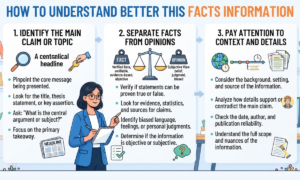
Identify the Main Claim or Topic
Start by finding the exact claim you want to understand. Instead of asking whether an entire article is “true,” break it into individual statements. Then determine what each statement actually says and what evidence is offered.
Questions such as these can help:
- What exactly is being claimed?
- Who or what does the claim apply to?
- What evidence is provided?
- Where did the information originally come from?
- Does the source support the exact wording of the claim?
Separate Facts From Opinions
An article may combine factual information with interpretation or advice. A published statistic is different from an author’s opinion about what the statistic means. Likewise, a recommendation is not automatically a factual conclusion.
Readers should therefore distinguish between evidence, interpretation, and opinion when reading BetterThisFacts or any other informational website.
Pay Attention to Context and Details
A statement can become misleading when important context is removed. For research, relevant context may include the study population, sample size, methodology, location, time period, and limitations.
For statistics, readers should also determine what is actually being measured and whether a figure represents a percentage, rate, average, estimate, or another type of measurement.
How to Check BetterThisFacts for Accuracy
Check the Original Source
Following an important claim back to its original source is one of the most useful verification steps. BetterThisWorld states that BetterThisFacts material can use primary sources, studies, reports, and data.
When a source is provided, readers should open BetterThisFacts From BetterThisWorld and check whether it actually supports the statement made in the article. A citation is not automatically proof. The underlying source still needs to be interpreted correctly.
Compare Information With Other Reliable Sources
For an important claim, compare the information with appropriate independent sources. Depending on the topic, useful sources might include government agencies, universities, peer-reviewed research, official datasets, research organizations, or original documents.
The purpose is not to find several websites repeating the same sentence. The goal is to find independent evidence that addresses the same question.
Check the Date and Relevance of the Information
Publication date matters. Some information remains useful for many years, while other information changes rapidly. Statistics, technology, scientific understanding, policies, and recommendations can become outdated.
The BetterThisWorld pages currently appearing in search results include articles published in June 2026, so readers should check the date of the particular article they are using.
Look for Evidence Supporting the Claim
Ask a simple question: What evidence supports this statement? If an article gives a specific statistic, look for the dataset or study behind BetterThisFacts From BetterThisWorld. If it describes a scientific finding, look for the original research. If it reports an official figure, look for the relevant institutional source.
This approach is more reliable than accepting a statement simply because it appears under the word “facts.”
What to Consider Before Trusting Online Facts
Check Who Published the Information
First identify the publisher. For BetterThisFacts From BetterThisWorld, BetterThisWorld.com is the primary website that publishes the BetterThisFacts material discussed in its own articles.
However, several other domains also publish pages using similar BetterThisFacts terminology. That makes checking the domain especially important.
Look for Clear and Verifiable Evidence
A website’s name or branding is not evidence by itself. BetterThisWorld describes BetterThisFacts as using sources and verification. Readers can strengthen that process by checking the evidence themselves. The more important the claim, the more important BetterThisFacts From BetterThisWorld is to locate the original supporting material.
Be Careful With Outdated or Misleading Information
Readers should be cautious when information:
- uses old statistics without explaining their age;
- makes broad conclusions from limited evidence;
- provides vague references;
- removes important qualifications; or
- presents an interpretation as though it were a directly established fact.
These are general source-evaluation principles and apply to BetterThisFacts as well as other online content.
Common Mistakes When Checking Online Information
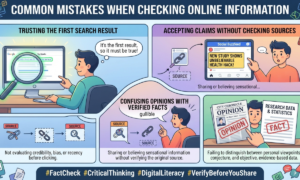
Trusting the First Search Result
A high search position does not automatically make a page authoritative. Search engines are useful discovery tools, but readers still need to assess the source, evidence, date, and context.
Accepting Claims Without Checking Sources
A confident writing style can make a claim appear stronger than BetterThisFacts From BetterThisWorld evidence. When a claim matters, follow its source and determine whether the evidence actually supports the statement.
Confusing Opinions With Verified Facts
A writer can provide useful advice without every recommendation being an independently established fact.
Before sharing information, determine whether the statement is evidence, interpretation, advice, or opinion. This simple distinction can prevent many misunderstandings.
Read more : Betterthisworld Stocks – Easy Guides & Expert Insights!
A Simple Way to Verify Online Facts
Start With the Original Claim
Write down the exact statement you want to verify. Checking one specific claim is much easier than attempting to determine whether an entire website is reliable.
Compare Multiple Sources
Search for independent evidence about the same claim. If the subject is scientific, locate the relevant research. If BetterThisFacts From BetterThisWorld concerns official statistics, check the responsible institution. If it concerns a public statement, look for the original statement or document.
Review the Available Evidence
Do not stop after finding a source. Check what the source actually says and consider its date, methodology, limitations, and relevance. Make sure the source supports the precise claim rather than only something loosely related to BetterThisFacts From BetterThisWorld.
Reach a Careful Understanding
Not every claim can be reduced to a simple “true” or “false.” Sometimes evidence strongly supports a statement. Sometimes BetterThisFacts From BetterThisWorld supports only part of it. Sometimes the available evidence is limited or mixed. A careful conclusion should reflect the strength and limitations of the evidence.
Final Thoughts on BetterThisFacts From BetterThisWorld
BetterThisFacts From BetterThisWorld is a phrase used by BetterThisWorld for fact-focused informational content. Its current pages describe a format built around concise claims, data, sources, and context. The most important point is that readers should distinguish between what BetterThisWorld says about BetterThisFacts and what can be independently established from the underlying evidence.
BetterThisWorld describes sourcing and verification practices, but the publicly available material reviewed does not establish BetterThisFacts as an independently accredited or audited fact-checking organization. That does not mean every BetterThisFacts claim is inaccurate. BetterThisFacts From BetterThisWorld means that important claims should be evaluated individually.
FAQs About BetterThisFacts From BetterThisWorld
What is BetterThisFacts from BetterThisWorld?
BetterThisFacts is a term used by BetterThisWorld for fact-focused informational content. BetterThisWorld’s 2026 pages describe it as concise information containing claims, summaries, data, sources, and context.
What information can readers find through BetterThisFacts?
The topics vary by article. BetterThisWorld’s pages describe subjects including science, health, environment, technology, policy, education, productivity, and personal development.
How can I check whether online information is accurate?
Identify the exact claim, examine the publisher and date, find the original source, review the evidence, and compare important claims with appropriate independent sources.
Why should I compare information from multiple sources?
Independent sources can reveal missing context, outdated information, errors, or differences in interpretation. However, multiple websites repeating the same claim are not necessarily independent confirmation.
What should I check before trusting an online fact?
Check the publisher, date, original source, supporting evidence, context, and limitations. For an important claim, inspect the underlying evidence rather than relying only on a short summary.