
The NVIDIA GeForce RTX 5090 is a flagship desktop graphics card built on NVIDIA’s Blackwell architecture. It combines a large number of CUDA cores with 32GB of GDDR7 memory, fifth-generation Tensor Cores, fourth-generation Ray Tracing Cores, and advanced AI-powered graphics technologies.
The RTX 5090 is designed for demanding gaming, ray tracing, content creation, AI workloads, and other applications that can take advantage of substantial GPU processing power. Its specifications include 21,760 CUDA cores, a 2.41 GHz boost clock, a 512-bit memory interface, and 1,792 GB/s of memory bandwidth.
What makes the NVIDIA GeForce RTX 5090 interesting is not simply one specification. Its Blackwell architecture, dedicated AI hardware, high memory capacity, ray-tracing capabilities, and DLSS technologies work together to handle workloads that can place significant demands on a modern GPU.
What Is the NVIDIA GeForce RTX 5090?
The NVIDIA GeForce RTX 5090 is the flagship desktop GPU in NVIDIA’s GeForce RTX 50 Series. It uses the Blackwell architecture and is aimed at users who want high-end graphics and GPU computing performance.
NVIDIA introduced the RTX 5090 alongside the RTX 50 Series as a new generation focused heavily on AI-assisted graphics, neural rendering, ray tracing, gaming, and creative workloads.
Overview of the NVIDIA GeForce RTX 5090
The RTX 5090 features 21,760 CUDA cores, fifth-generation Tensor Cores, and fourth-generation Ray Tracing Cores. NVIDIA lists a 2.01 GHz base clock and a 2.41 GHz boost clock for its reference specifications.
The card also includes 32GB of GDDR7 memory and a 512-bit memory interface. These specifications give the GPU a substantial memory subsystem for demanding games, creative applications, and GPU-accelerated workloads.
Where the RTX 5090 Fits in NVIDIA’s GPU Lineup
The RTX 5090 sits at the top of NVIDIA’s current GeForce RTX 50 Series desktop lineup. Below it are models including the RTX 5080, RTX 5070 Ti, RTX 5070, RTX 5060 Ti, RTX 5060, and RTX 5050.
The RTX 5090 has the highest CUDA-core count, memory capacity, memory interface width, and listed AI performance among these desktop RTX 50 Series models.
NVIDIA GeForce RTX 5090 Key Specifications
The specifications of the RTX 5090 help explain the type of workloads for which it is designed. Its combination of processing cores, memory, connectivity, and dedicated AI and ray-tracing hardware gives it a broad range of capabilities.
CUDA Cores, Clock Speeds, and GPU Architecture
The NVIDIA GeForce RTX 5090 has 21,760 CUDA cores and uses NVIDIA’s Blackwell architecture.
Its reference specifications list a 2.01 GHz base clock and a 2.41 GHz boost clock. The GPU also includes fifth-generation Tensor Cores for AI processing and fourth-generation Ray Tracing Cores for accelerated ray-traced workloads.
VRAM Capacity and Memory Bandwidth
The RTX 5090 comes with 32GB of GDDR7 memory connected through a 512-bit interface.
NVIDIA lists memory bandwidth of 1,792 GB/s. The combination of high memory capacity and bandwidth is important for workloads that need to move large amounts of data between GPU memory and the processing hardware.
For gaming, additional VRAM can be useful at high resolutions and with demanding graphics settings. For creative and AI workloads, memory capacity can also matter when working with large projects, models, scenes, or datasets.
Display Outputs and Connectivity
The reference RTX 5090 design provides three DisplayPort connections and one HDMI connection. NVIDIA lists DisplayPort 2.1b with UHBR20 and HDMI 2.1b support.
The card supports up to four displays. NVIDIA lists configurations reaching up to 4K at 480Hz or 8K at 165Hz with Display Stream Compression, depending on the connection and display configuration.
What Makes the NVIDIA GeForce RTX 5090 So Powerful?
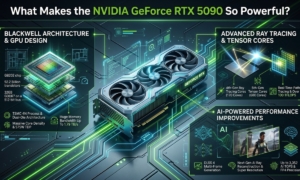
The NVIDIA GeForce RTX 5090 gets its performance capabilities from several technologies working together. Blackwell architecture provides the foundation, while CUDA cores, Tensor Cores, Ray Tracing Cores, GDDR7 memory, and AI-powered rendering technologies address different parts of the workload.
Blackwell Architecture and GPU Design
Blackwell is the architecture behind NVIDIA’s GeForce RTX 50 Series.
The architecture introduces new Streaming Multiprocessors, fifth-generation Tensor Cores, and fourth-generation Ray Tracing Cores. NVIDIA also designed Blackwell around neural rendering and AI-assisted graphics.
This approach reflects the changing role of GPUs. Modern graphics workloads increasingly combine traditional rasterization and ray tracing with AI-based image reconstruction, frame generation, and neural rendering.
Advanced Ray Tracing and Tensor Core Technology
Ray tracing allows supported games and applications to calculate lighting, reflections, shadows, and other effects using ray-based techniques.
The NVIDIA GeForce RTX 5090 uses fourth-generation Ray Tracing Cores to accelerate these workloads. NVIDIA also designed the Blackwell architecture for advanced geometry and path-tracing workloads.
Tensor Cores handle AI-oriented calculations. The RTX 5090 uses fifth-generation Tensor Cores and provides 3,352 AI TOPS according to NVIDIA’s current specifications.
AI-Powered Performance Improvements
AI is one of the central features of the RTX 5090 generation.
The GPU can use its Tensor Cores for AI-assisted graphics technologies, image reconstruction, frame generation, neural rendering, and supported creative or generative-AI applications.
NVIDIA also introduced FP4 support with the RTX 50 Series. Lower-precision AI processing can reduce the memory requirements of supported generative-AI models while providing high computational throughput.
NVIDIA GeForce RTX 5090 Gaming Performance
The NVIDIA GeForce RTX 5090 is designed for demanding PC gaming, particularly when high resolutions, advanced ray tracing, and modern AI-assisted rendering technologies are used.
4K and High-Resolution Gaming
4K gaming can place considerable demands on a graphics card because the GPU has to render a large number of pixels for every frame.
The RTX 5090 has the processing resources and memory capacity required for demanding high-resolution gaming. NVIDIA also demonstrates the card using 4K resolution, high graphics settings, ray tracing, and DLSS technologies.
Ray Tracing and Visual Quality
Ray tracing can improve the realism of lighting, reflections, shadows, and other visual effects, but NVIDIA GeForce RTX 5090 also increases the workload placed on a GPU.
The RTX 5090 combines fourth-generation Ray Tracing Cores with AI technologies designed to make advanced rendering techniques more practical.
This is particularly relevant for games using demanding ray tracing or path tracing. The exact visual and performance benefits depend on how each game implements these technologies.
High-Refresh-Rate Gaming
High-refresh-rate gaming requires a graphics card capable of producing frames quickly enough to take advantage of a fast display.
The RTX 5090 can be paired with high-refresh-rate monitors, while technologies such as DLSS and NVIDIA Reflex can play a role in supported games.
NVIDIA GeForce RTX 5090 is important to distinguish between traditionally rendered frames and AI-generated frames. Frame-generation technologies can increase the displayed frame rate, but they work differently from rendering every frame directly through the conventional graphics pipeline.
DLSS and AI Features on the RTX 5090
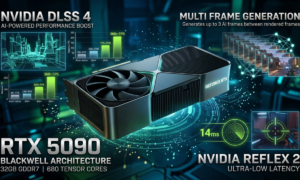
DLSS is a major part of NVIDIA’s RTX ecosystem. NVIDIA GeForce RTX 5090 uses AI models to reconstruct images and, on supported hardware and games, generate additional frames.
The RTX 5090 supports DLSS technologies and NVIDIA’s newer DLSS features for the GeForce RTX 50 Series.
How DLSS 4 Enhances Gaming Performance
DLSS 4 introduced improvements to several AI-based rendering technologies, including Super Resolution, Ray Reconstruction, Frame Generation, and Multi Frame Generation.
One important change was the use of transformer-based models for DLSS Super Resolution, Ray Reconstruction, and DLAA. These models are designed to improve image stability, detail, and temporal behavior in supported games.
Multi Frame Generation Technology
DLSS Multi Frame Generation was introduced with the RTX 50 Series.
NVIDIA GeForce RTX 5090 uses AI and the RTX 50 Series Tensor Cores to generate additional frames between traditionally rendered frames. NVIDIA originally described DLSS 4 Multi Frame Generation as generating up to three additional frames for each traditionally rendered frame.
NVIDIA Reflex and Other Gaming Technologies
NVIDIA Reflex is designed to reduce system latency by optimizing the relationship between the CPU, GPU, and display pipeline.
The RTX 5090 supports Reflex 2 features, alongside technologies such as G-SYNC, Game Ready Drivers, NVIDIA App features, and other GeForce technologies.
NVIDIA GeForce RTX 5090 for Content Creation
The NVIDIA GeForce RTX 5090 is also built for demanding creative workflows.
Its CUDA cores, Tensor Cores, Ray Tracing Cores, 32GB of GDDR7 memory, and dedicated video engines can accelerate supported applications used for video editing, 3D rendering, AI, and other professional workloads.
Video Editing and Rendering
The RTX 5090 includes three ninth-generation NVIDIA NVENC encoders and two sixth-generation NVDEC decoders.
NVIDIA GeForce RTX 5090 supports AV1 encoding and decoding, along with other modern video technologies. These dedicated engines can accelerate supported video-processing and export workloads.
3D Design and Creative Workloads
3D applications can benefit from GPU acceleration for rendering, viewport work, lighting, and other supported tasks.
The RTX 5090’s fourth-generation Ray Tracing Cores can accelerate ray-traced workloads, while its large 32GB memory capacity can be useful for complex scenes and other projects that require substantial GPU memory.
NVIDIA also supports the RTX 5090 through its Studio ecosystem, which includes creator-focused drivers and software technologies.
AI and Machine Learning Applications
The NVIDIA GeForce RTX 5090 provides substantial AI processing capability through its fifth-generation Tensor Cores.
NVIDIA lists 3,352 AI TOPS for the RTX 5090. The card’s 32GB of VRAM can also be useful for supported local AI applications where model size and memory requirements are important considerations.
NVIDIA GeForce RTX 5090 vs Previous-Generation GPUs
The RTX 5090 introduced several hardware changes compared with the previous flagship RTX 4090.
RTX 5090 vs RTX 4090
The RTX 5090 uses Blackwell, while the RTX 4090 uses Ada Lovelace.
The RTX 5090 has 21,760 CUDA cores compared with 16,384 on the RTX 4090. NVIDIA GeForce RTX 5090 also provides 32GB of GDDR7 memory compared with 24GB of GDDR6X on the RTX 4090.
The memory interface increases from 384-bit on the RTX 4090 to 512-bit on the RTX 5090. NVIDIA lists 1,792 GB/s of memory bandwidth for the RTX 5090.
Major Performance and Feature Differences
The differences between the RTX 5090 and RTX 4090 extend beyond raw core counts.
The RTX 5090 adds GDDR7 memory, newer Tensor and Ray Tracing Cores, PCI Express 5.0, DLSS 4 Multi Frame Generation support, newer display connectivity, and newer video-processing hardware.
NVIDIA has also published performance comparisons showing substantial gains for the RTX 5090 in selected workloads. These comparisons use specific games, settings, resolutions, and DLSS configurations, so they should not be interpreted as a universal performance increase across every application.
Should You Upgrade to the RTX 5090?
An upgrade decision depends heavily on the graphics card currently being used and the workload.
Someone using an older-generation GPU may gain access to newer ray tracing, AI, DLSS, memory, and display technologies. An RTX 4090 owner already has a high-end GPU, so the relevant question is whether the RTX 5090’s additional performance and newer features justify the cost and system requirements for that particular workload.
RTX 5090 Power, Cooling, and System Requirements
The RTX 5090 is a high-power graphics card, so the rest of the computer should be planned accordingly.
Power Supply Requirements
NVIDIA lists 575W as the RTX 5090’s Total Graphics Power and recommends a 1,000W system power supply for its reference configuration.
NVIDIA’s stated minimum is based on a system using a Ryzen 9 9950X processor, so actual requirements can differ depending on the complete system.
Cooling and Thermal Considerations
NVIDIA lists a maximum GPU temperature of 90°C for the reference RTX 5090 specification.
Because the RTX 5090 can draw substantial power under demanding workloads, adequate case airflow and graphics-card cooling are important.
Cooling design varies between manufacturers. A third-party RTX 5090 may have different dimensions, cooler size, fan configuration, or power requirements, so buyers should check the specifications of the exact model.
Choosing Compatible PC Components
The reference RTX 5090 measures 304 mm in length and 137 mm in width, although partner graphics cards can differ.
Before installing the card, users should check:
- Power-supply capacity
- Available power connectors
- Case length and width clearance
- Graphics-card thickness
- Motherboard compatibility
- Case airflow
- CPU performance
- Monitor resolution and refresh rate
A compatible system is important because a flagship GPU cannot perform at its best if the supporting hardware creates a significant limitation.
NVIDIA GeForce RTX 5090 Pros and Cons
The RTX 5090 has an extensive feature set, but its capabilities also come with practical considerations.
Key Advantages of the RTX 5090
The main strengths of the NVIDIA GeForce RTX 5090 include:
- 21,760 CUDA cores
- 32GB of GDDR7 memory
- 512-bit memory interface
- 1,792 GB/s memory bandwidth
- Fifth-generation Tensor Cores
- Fourth-generation Ray Tracing Cores
- DLSS 4 support
- Multi Frame Generation support
- PCI Express 5.0
- Three ninth-generation NVENC encoders
- Two sixth-generation NVDEC decoders
- AV1 encoding and decoding
- Support for advanced high-resolution and high-refresh-rate displays
Together, these features make the RTX 5090 capable of handling a wide range of demanding GPU workloads.
Potential Limitations to Consider
The most obvious practical consideration is power consumption. NVIDIA lists 575W Total Graphics Power and recommends a 1,000W system power supply for its reference configuration.
Physical size and cooling also need attention. Not every PC case can comfortably accommodate a high-end RTX 5090 model.
Another consideration is software support. Features such as Multi Frame Generation and advanced DLSS technologies require compatible games or applications.
Read more : When Is the Best Time of Year for Roof Washing?
Who Should Consider the NVIDIA GeForce RTX 5090?
The NVIDIA GeForce RTX 5090 is most relevant to users whose workloads can take advantage of its high-end processing, memory, ray tracing, and AI capabilities.
Gamers Looking for High-End Performance
The RTX 5090 is designed for demanding gaming workloads, including high-resolution gaming and titles that use advanced ray tracing or path tracing.
Gamers with high-refresh-rate 4K displays may also be able to take advantage of the GPU’s processing capability and supported DLSS technologies.
Content Creators and Professionals
Video editors, 3D artists, designers, and other creators can benefit from the RTX 5090’s large VRAM capacity, CUDA processing, ray-tracing hardware, and dedicated video engines.
The actual benefit depends on the applications being used and how effectively they support GPU acceleration.
Users Who Need Advanced AI and GPU Computing
Users working with supported generative-AI applications, local AI models, neural rendering, and GPU-accelerated computing can make use of the RTX 5090’s Tensor Cores and 32GB of memory.
The card can be particularly useful when an application requires substantial GPU memory or benefits from NVIDIA’s CUDA and AI ecosystem.
Final Thoughts
The NVIDIA GeForce RTX 5090 is powerful because several major technologies are combined in one GPU. Its Blackwell architecture provides the foundation, while 21,760 CUDA cores, 32GB of GDDR7 memory, fifth-generation Tensor Cores, and fourth-generation Ray Tracing Cores address different types of demanding workloads.
Its capabilities extend beyond traditional gaming. The RTX 5090 can also accelerate supported video-production, 3D-rendering, AI, and GPU-computing workloads.
DLSS and other AI-based technologies are another important part of the RTX 5090 story. Rather than relying exclusively on traditional rendering, supported games can use AI for image reconstruction and frame generation, while newer NVIDIA technologies continue to expand the role of neural rendering.
FAQs About NVIDIA GeForce RTX 5090
How powerful is the NVIDIA GeForce RTX 5090?
The NVIDIA GeForce RTX 5090 is the flagship GeForce RTX 50 Series desktop GPU, featuring 21,760 CUDA cores and 32GB of GDDR7 memory.
Is the RTX 5090 good for 4K gaming?
Yes, the RTX 5090 is designed for demanding high-resolution gaming, including 4K gaming with advanced graphics settings. Actual performance depends on the game, CPU, graphics settings, ray tracing, resolution, and DLSS features being used.
How much VRAM does the RTX 5090 have?
The NVIDIA GeForce RTX 5090 has 32GB of GDDR7 VRAM with a 512-bit memory interface. NVIDIA lists a memory bandwidth of up to 1,792 GB/s, supporting demanding gaming, creative, and GPU computing workloads.
What makes the RTX 5090 different from the RTX 4090?
The RTX 5090 uses Blackwell architecture, 21,760 CUDA cores, 32GB GDDR7, and fifth-generation Tensor Cores with fourth-generation Ray Tracing Cores.
The RTX 4090 uses Ada Lovelace, 16,384 CUDA cores, 24GB GDDR6X, fourth-generation Tensor Cores, and third-generation Ray Tracing Cores.
Does the RTX 5090 support DLSS 4?
Yes, the RTX 5090 supports DLSS 4 technologies, including Super Resolution, Ray Reconstruction, Frame Generation, and Multi Frame Generation.